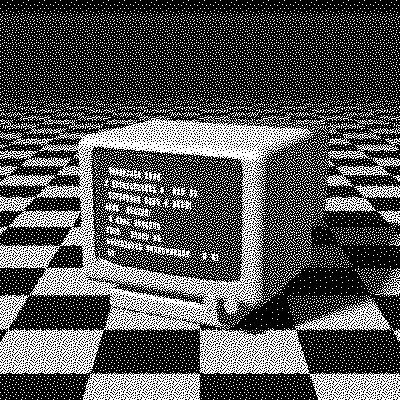
Void-and-Cluster Dithering
Void-and-cluster is Robert Ulichney’s 1993 method for building ordered dither arrays with blue-noise properties. It repeatedly finds the tightest cluster of dots and the largest void between them, and uses them to rank every position in the array. PixelSynth uses a classic 16×16 array, which gives a smooth, organic texture with a faint repeating rhythm.
- Author
- Robert Ulichney
- Year
- 1993
- Complexity
- high
How Void-and-Cluster dithering works
Building the array starts from a few random dots, which are relaxed by moving the dot in the tightest cluster into the largest void until nothing changes. Then every position is ranked: removing dots from the tightest clusters numbers the ranks below, and filling the largest voids numbers the ranks above. Clusters and voids are measured with a Gaussian blur on a grid that wraps around, so the tile has no seams.
Dithering with it works like Bayer: the 16×16 array of 256 ranks is tiled across the image, and each pixel turns white when its brightness exceeds the threshold at its position. That gives 257 levels, with dots dispersed evenly and none of Bayer’s cross-hatch.
| 237 | 138 | 15 | 255 | 118 | 70 | 238 | 123 |
| 111 | 39 | 158 | 57 | 200 | 143 | 50 | 181 |
| 180 | 71 | 214 | 96 | 22 | 221 | 105 | 13 |
| 25 | 240 | 125 | 185 | 161 | 41 | 173 | 242 |
| 196 | 149 | 10 | 79 | 248 | 136 | 67 | 94 |
| 103 | 40 | 231 | 53 | 113 | 5 | 198 | 232 |
| 64 | 171 | 121 | 209 | 90 | 219 | 150 | 24 |
| 139 | 201 | 28 | 154 | 179 | 44 | 127 | 107 |
- A 16×16 matrix of 256 ranks is tiled across the image; a pixel turns white when its brightness exceeds the threshold at its position.
- That gives 257 distinct gray levels, each reproduced by a fixed dot pattern.
- Showing the top-left 8×8 corner of the full 16×16 matrix.
M = 16×16 matrix of ranks 0…255
for each pixel (x, y):
  t = (M[y mod 16][x mod 16] + 0.5) / 256 * 255
  pixel = gray < t ? black : white
# with a palette, t shifts the color before nearest_color
When to use it (and when not to)
- Best for: a smooth, organic texture that is still ordered, and animation.
- Works well with: any palette, and 1-bit with tone mapping.
- Watch out for: the 16-pixel period can show faintly in large flat areas; Blue Noise uses a 64×64 mask to hide it.
- In animation: Very stable. Each pixel’s threshold depends only on its position, so areas that don’t move stay identical from frame to frame, with no shimmer.
Void-and-Cluster vs other algorithms
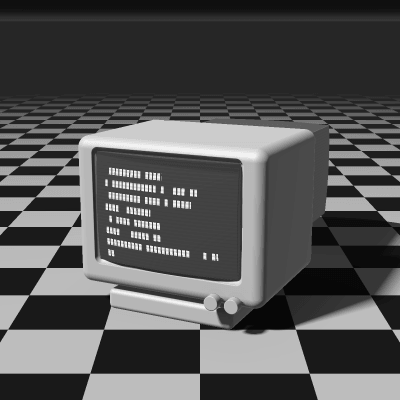
The same terminal in 1-bit, center crop at actual size.
Void-and-Cluster 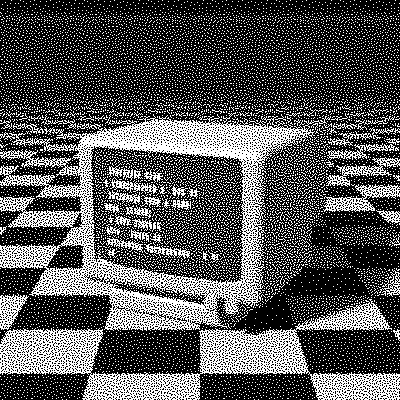
Blue Noise 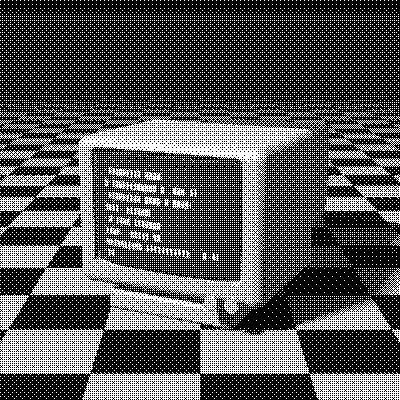
Bayer 8×8 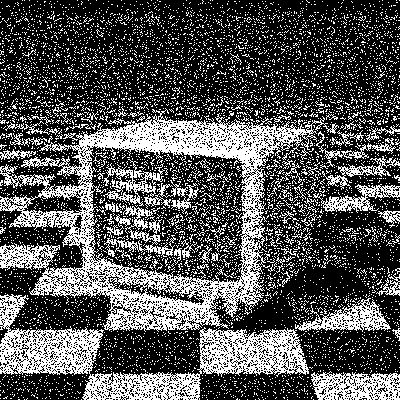
Random
| Algorithm | Method | Animation | Look |
|---|---|---|---|
| Void-and-Cluster | 16×16 threshold matrix | Stable | Organic, faint 16 px rhythm |
| Blue Noise | 64×64 threshold matrix | Stable | Same method, no visible repeat |
| Bayer 8×8 | 8×8 threshold matrix | Stable | Regular cross-hatch |
| Random | Random threshold | Stable | Unbalanced, clumpy grain |
Try Void-and-Cluster on your image
Open the editor with Void-and-Cluster already selected, drop in a photo or an animated GIF, choose the processing scale for the dot size, pick a palette and export the result. Free, no account, no watermark, and your image never leaves your device.
Open Void-and-Cluster in the editorVoid-and-Cluster FAQ
What does void-and-cluster mean?
A “cluster” is where dots are packed tightest, a “void” where the biggest gap is. The method ranks positions by repeatedly removing dots from clusters and filling voids, so every gray level is as evenly spread as possible.
Void-and-Cluster or Blue Noise?
They come from the same method. Blue Noise uses a larger mask for a grain with no visible repetition; Void-and-Cluster’s smaller array has a slight rhythm that some images benefit from.