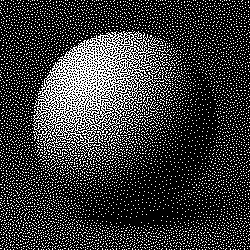
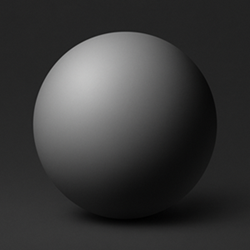
 SourceDithered
13Ordered
Blue Noise
Uses a blue-noise matrix for balanced error distribution. Avoids visible patterns, producing a natural look.
- Author
- Robert Ulichney
- Year
- 1993
- Complexity
- high
- Processing cost
- 4 / 5
How it works
Each pixel is compared with a threshold matrix tiled across the image. Fast, parallel and deliberately textured.
| 2391 | 363 | 2166 | 263 | 1291 | 2327 | 2665 | 2138 |
| 2676 | 1398 | 4021 | 2954 | 1883 | 3846 | 3477 | 831 |
| 3161 | 2019 | 3442 | 1095 | 699 | 68 | 1657 | 2919 |
| 949 | 558 | 1692 | 2755 | 2517 | 3298 | 2049 | 1037 |
| 2355 | 3837 | 147 | 1478 | 3652 | 508 | 3081 | 4058 |
| 1894 | 3313 | 2898 | 2196 | 901 | 2401 | 1268 | 234 |
| 446 | 746 | 1145 | 3972 | 324 | 1853 | 3739 | 767 |
| 1453 | 2506 | 2008 | 3453 | 1619 | 3180 | 2584 | 3508 |
- A 64×64 matrix of 4096 ranks is tiled across the image; a pixel turns white when its brightness exceeds the threshold at its position.
- That gives 4097 distinct gray levels, each reproduced by a fixed dot pattern.
- Showing the top-left 8×8 corner of the full 64×64 matrix.