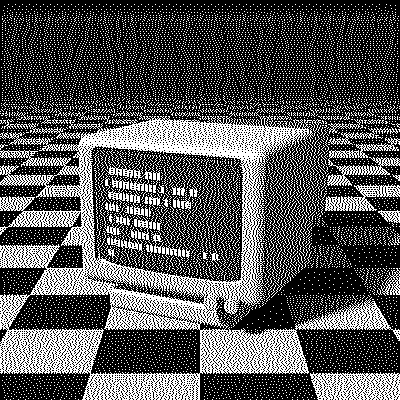
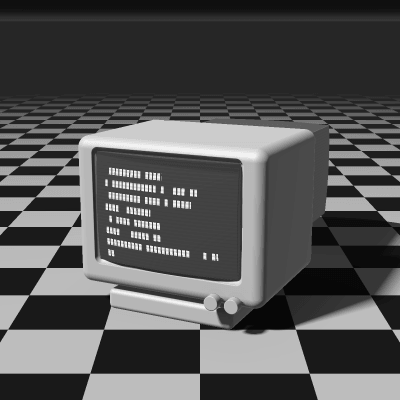
Two-Row Sierra Dithering
Two-Row Sierra is the reduced version of the Sierra filter that Frankie Sierra published a year after it, in 1990. It drops the third row and spreads each pixel’s error over 7 neighbors on just two rows, so it runs faster while keeping most of the smoothness of the full filter.
- Author
- Frankie Sierra
- Year
- 1990
- Complexity
- medium
How Two-Row Sierra dithering works
Each pixel is rounded to the nearest available color and its error is split into 16ths: 4 and 3 go to the next two pixels on the row, and 1, 2, 3, 2, 1 to the five pixels below.
It has the same footprint as Burkes, but its weights fall off more gently: the pixel two steps ahead gets 3/16 instead of Burkes’ 2/16, and the one straight below 3/16 instead of 4/16. The error spreads a little wider along the row, for a softer, more even texture.
| Current pixel | 4/16 | 3/16 | ||
| 1/16 | 2/16 | 3/16 | 2/16 | 1/16 |
- The error of the current pixel is spread over 7 neighbors that haven’t been processed yet.
- All of the error is carried forward.
- Rows are scanned in alternating directions (serpentine), which avoids diagonal streaks.
for each row y, top to bottom:
  # odd rows go right to left, mirroring dx
  for each x in the row:
    old = pixel[x][y]
    new = nearest_color(old)
    pixel[x][y] = new
    error = old - new
    pixel[x+1][y  ] += error * 4/16
    pixel[x+2][y  ] += error * 3/16
    pixel[x-2][y+1] += error * 1/16
    pixel[x-1][y+1] += error * 2/16
    pixel[x  ][y+1] += error * 3/16
    pixel[x+1][y+1] += error * 2/16
    pixel[x+2][y+1] += error * 1/16
When to use it (and when not to)
- Best for: a good middle ground between speed and smoothness on large images.
- Works well with: 1-bit output and retro palettes like the Game Boy’s four greens.
- Watch out for: slightly grainier gradients than the three-row Sierra.
- In animation: Like every error diffusion, it flickers: a small change in one frame moves every later dot. For GIFs, Bayer 8×8 or Blue Noise keep their dots in place.
Two-Row Sierra vs other algorithms
The same terminal in 1-bit, center crop at actual size.
Two-Row Sierra 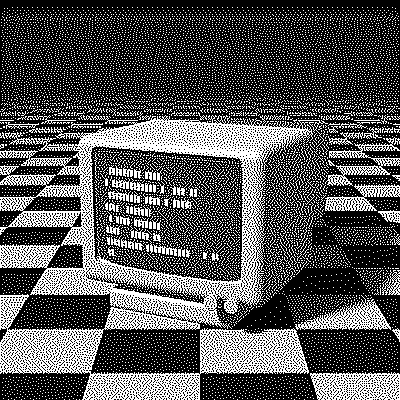
Sierra 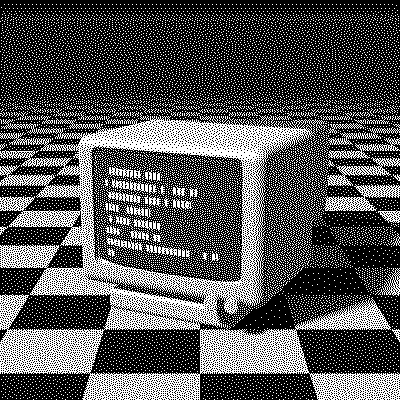
Sierra Lite 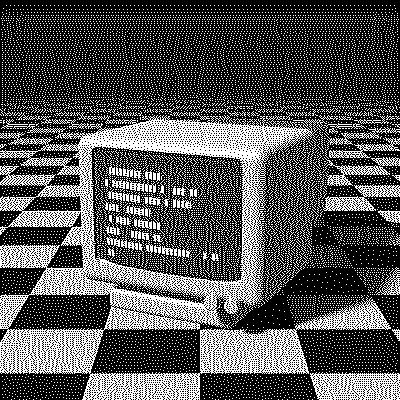
Burkes
| Algorithm | Method | Animation | Look |
|---|---|---|---|
| Two-Row Sierra | Error to 7 neighbors (100% carried) | Flickers | Soft, even, fast |
| Sierra | Error to 10 neighbors (100% carried) | Flickers | Smoother, more work |
| Sierra Lite | Error to 3 neighbors (100% carried) | Flickers | Grainier, fastest |
| Burkes | Error to 7 neighbors (100% carried) | Flickers | Same footprint, crisper |
Try Two-Row Sierra on your image
Open the editor with Two-Row Sierra already selected, drop in a photo or an animated GIF, adjust how much error travels with the Error diffusion slider, pick a palette and export the result. Free, no account, no watermark, and your image never leaves your device.
Open Two-Row Sierra in the editorTwo-Row Sierra FAQ
Two-Row Sierra or Burkes?
Both reach the same 7 neighbors. Burkes keeps more of the error close to the current pixel for a crisper look; Two-Row Sierra spreads it more evenly for a softer one.